
Used by NASA · the FBI · the U.S. Navy · Since 1999
USB Flash Drive Data Loss: What Your Symptoms Actually Mean
- No Data, No Data Recovery Fee
- Free, confidential evaluation
- 4.9 / 5 on Trustpilot (67 reviews)
- Worldwide lab recovery
Most people don’t know their USB flash drive is failing until it already has — and by then, the instinct is almost always the wrong one: unplug it, plug it back in, try another port, run a repair tool. Every one of those steps can be fine on a healthy drive and actively harmful on a failing one. The symptom your drive is showing right now is actually useful information — it tells you roughly what’s wrong and, more importantly, what you should and shouldn’t do next.
This isn’t a list of why flash drives fail in general — for that mechanical breakdown see our USB flash drive recovery service page. This is a triage guide: match what your drive is doing to the symptom below, and follow the action next to it before you do anything else.
What Does My USB Flash Drive Symptom Mean?
Most USB flash drive symptoms — not showing up, a “please insert a disk” error, corrupted files, or visible physical damage — point to a failed connector or controller, not damaged NAND memory. The safest first move for almost every symptom is the same: stop using the drive and get it evaluated before trying another fix.
“The symptom tells you what’s broken. It almost never tells you the data is gone.” — Bruce Cullen, founder, eProvided
- Why the Symptom Matters
- Symptom Checklist: What to Do for Each One
- Symptom 1: Drive Doesn't Show Up At All
- Symptom 2: “Please Insert a Disk” or RAW Format
- Symptom 3: Hot, Clicking, or a Burnt Smell
- Symptom 4: Files Are There But Won't Open
- Symptom 5: Visible Physical Damage
- What Not to Do the Moment You Notice a Symptom
- Our Recovery Process
- Customer Reviews
- Frequently Asked Questions
- Data Recovery for Every Device We Handle
Why the Symptom Matters

A USB flash drive has three points of failure: the connector, the controller chip, and the NAND memory chip that actually stores your files. Each symptom below tends to come from a different one of those three — and two of the three (the connector and the controller) don’t touch your data at all when they fail. Only NAND damage itself puts data at real risk, and that’s the least common failure of the three.
That's why guessing wrong and reaching for the nearest fix — a format prompt, a different cable, a repair utility — is the single biggest cause of a recoverable drive becoming unrecoverable. Match the symptom first.
Symptom Checklist: What to Do for Each One
| USB Flash Drive Symptom Checklist | ||
|---|---|---|
| Symptom | Right Now, Do This | Recovery Outlook |
| Not detected at all | Stop trying other ports/computers — each attempt stresses a failing connector further | ✓ High Recovery Chance |
| “Please insert a disk” / RAW | Do NOT click Format — that prompt does not mean the files are gone | ✓ Very Likely Recoverable |
| Hot, clicking, or burnt smell | Unplug it immediately and leave it unplugged — this is active electrical failure | ⚠ Damage Dependent, Good Chances |
| Files visible but won't open | Stop copying/saving to the same drive — you can overwrite recoverable data | ✓ Excellent Odds |
| Bent, cracked, or snapped | Don’t force it into a port — a partial connection can finish the damage | ✓ Excellent Odds if NAND Intact |
A “please insert a disk” or RAW-format error is a file-system message, not a NAND-memory message. The chip holding your files is very often still fully intact underneath a broken file table — formatting is simply the one action that makes that file table impossible to rebuild.
Symptom 1: Drive Doesn't Show Up At All
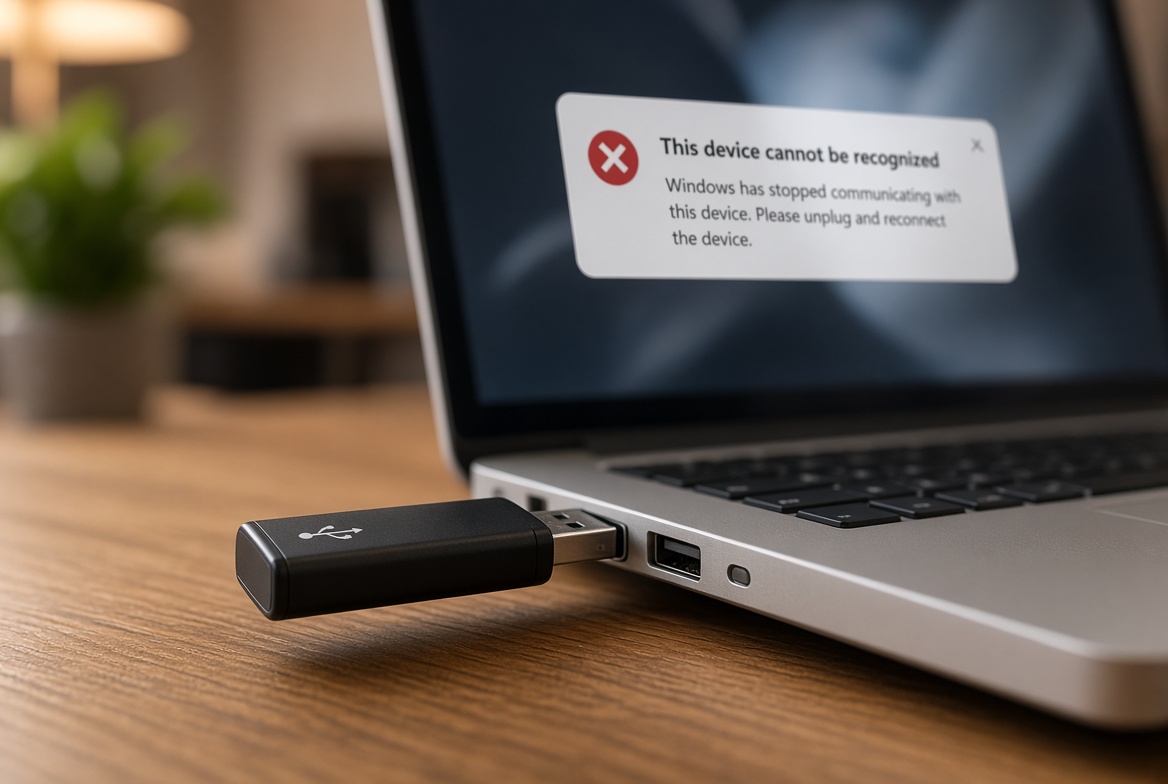
No drive letter, no notification, nothing in Disk Management — as if the drive were never plugged in. This is almost always the connector or the controller chip failing to establish a connection at all, not the NAND memory losing its contents. Repeatedly trying different ports or computers doesn’t diagnose anything; it just adds more wear to a connection that’s already failing.
Under the microscope, our engineers check the connector solder points and controller first. If the connection can be restored directly, we do that. If not, we bypass it with a direct NAND chip-off read — the same underlying technique used across every USB failure type we see. Either path starts with the same free evaluation, and neither one depends on the drive ever mounting again on its own.
Symptom 2: “Please Insert a Disk” or RAW Format
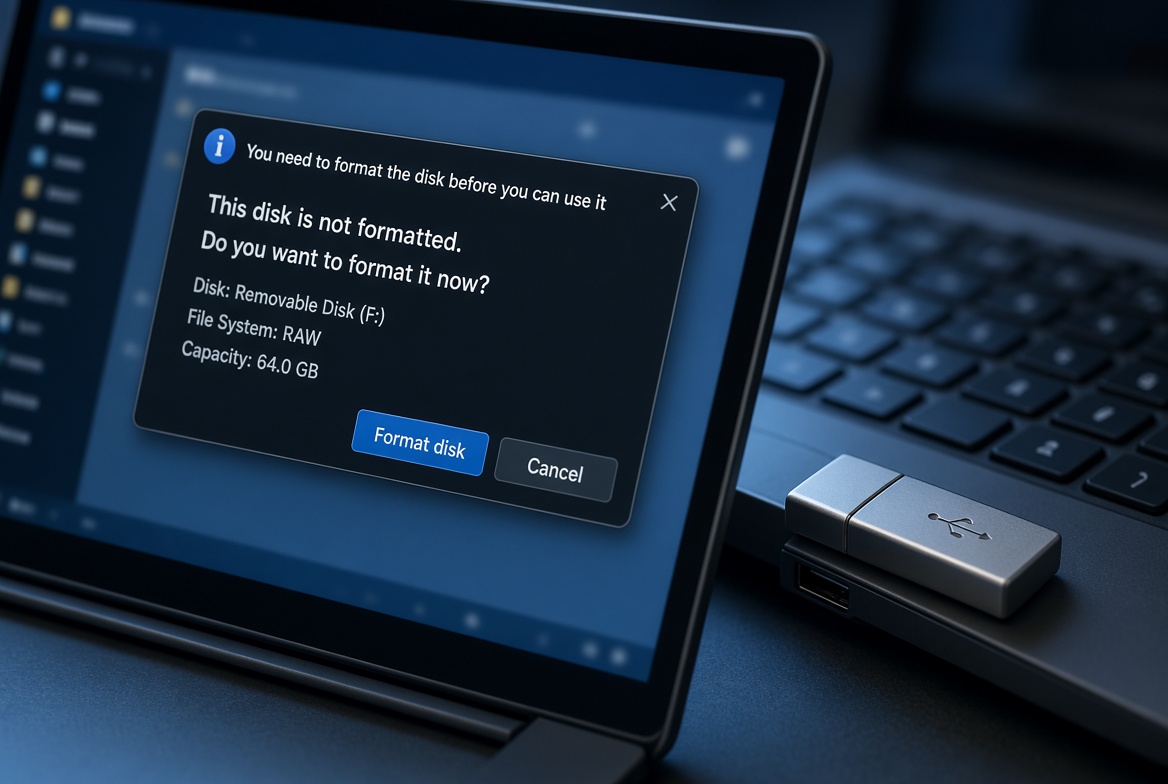
Windows shows this when it can see the drive electrically but can't read a valid file system on it — corrupted partition table or file allocation structure, not necessarily damaged memory. Windows will typically offer to format the drive right there in the same dialog. That single click rewrites the file table pointers, and once that happens, rebuilding the original folder structure gets dramatically harder even though most of the underlying data is often still physically present.
Our approach here is a raw, sector-level image of the drive first — before any repair attempt touches the original media — then file-system reconstruction from that image. The original drive is never modified.
Symptom 3: Hot, Clicking, or a Burnt Smell
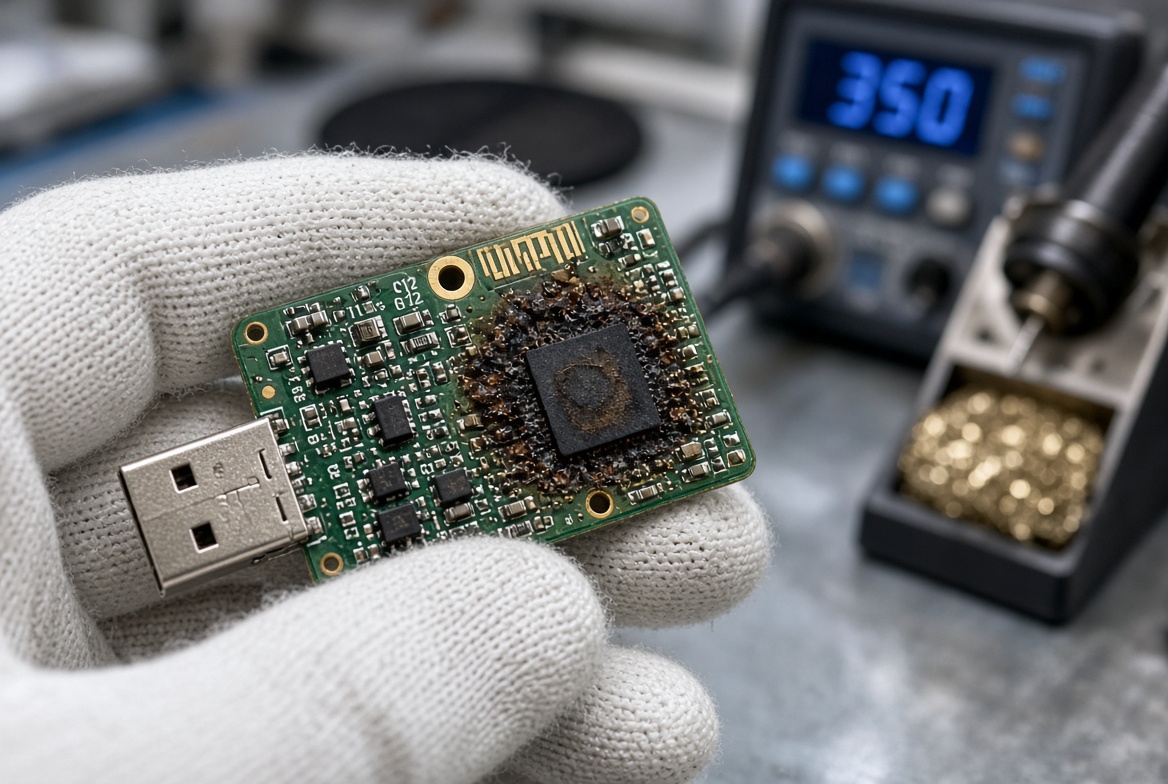
This is the one symptom where speed matters more than any other: a drive that's noticeably hot, making an audible click, or giving off a burning smell is failing electrically right now, not intermittently. Continuing to power it on risks spreading damage from the controller into the NAND chip itself, which is the one component that actually holds your data.
Unplug it, let it cool without powering it back on, and get it evaluated. Cases like this are damage-dependent, but the outcome is almost always determined by how quickly the drive stopped being used after the symptom appeared — not by the symptom itself.
Symptom 4: Files Are There But Won't Open
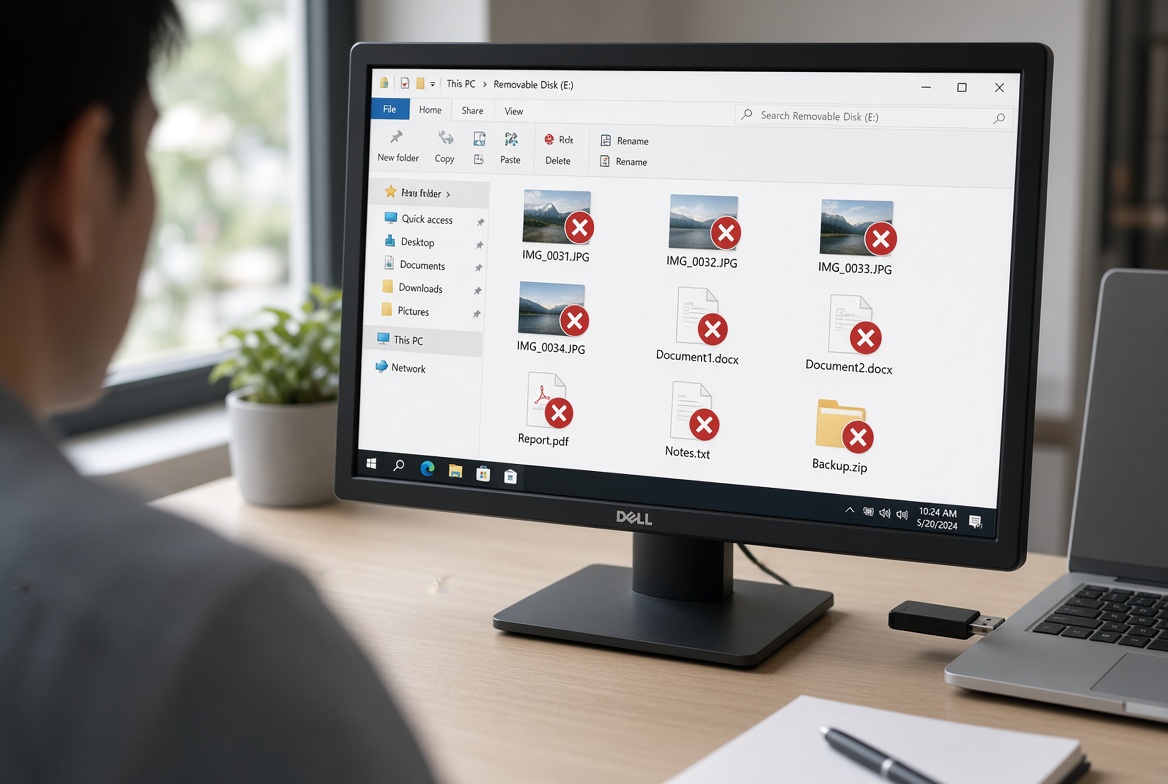
The drive mounts normally, file names and folders look correct, but individual files won't open, show as 0 bytes, or produce an error when copied. This usually points to bad blocks developing on the NAND chip itself — the one symptom on this list that does involve the memory directly, though it’s rarely total. Continuing to write new files to the same drive risks the new data landing on the same failing blocks, or overwriting the very sectors a recovery would need.
A word on encrypted USB drives specifically: most consumer flash drives store data with no encryption at all, which is exactly why a direct NAND chip-off works so well on them — the chip holds plain, readable data once extracted. A small number of drives use hardware encryption (BitLocker To Go, or a built-in fingerprint/PIN-secured model) where the decryption key lives on a security chip separate from the NAND. On those specific drives, pulling the NAND chip alone returns unreadable ciphertext — the honest path there is repairing the drive’s own controller board so the original security chip can still unlock it, not chip-off. We determine which category a drive falls into during the free evaluation, before any work begins.
Symptom 5: Visible Physical Damage
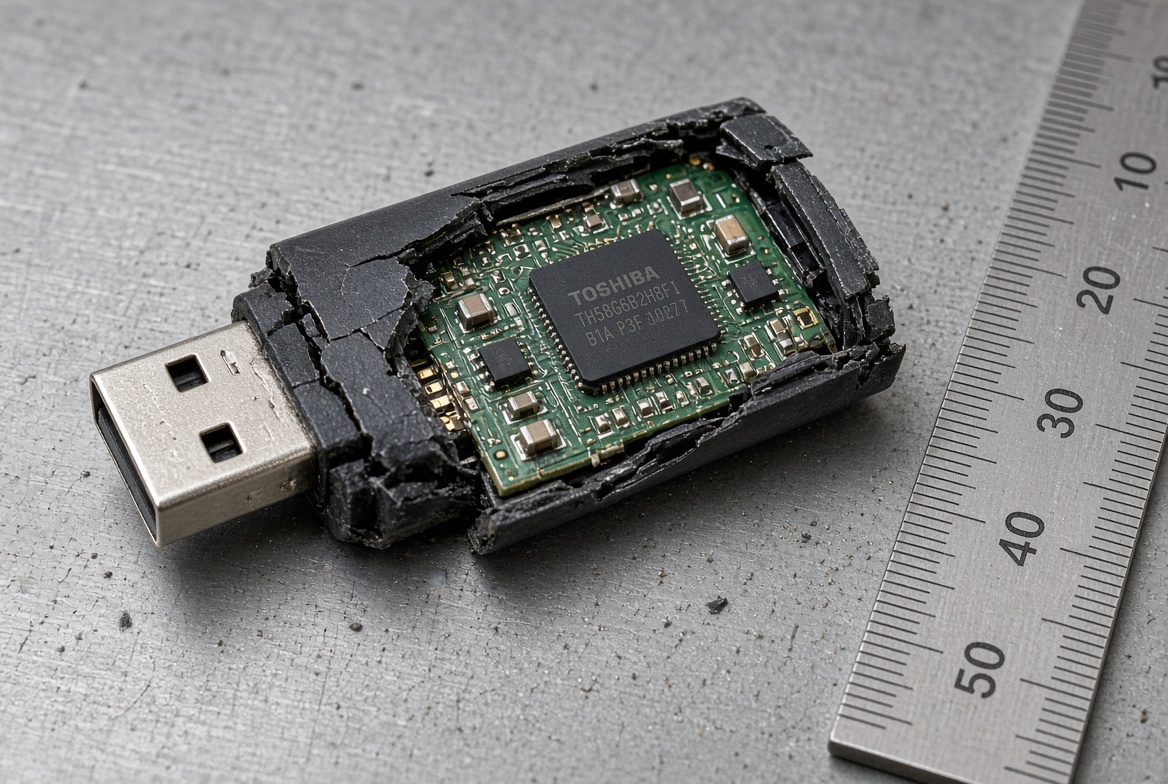
A bent, cracked, or snapped connector is the most obvious symptom on this list — and often the least serious for your data. The NAND chip sits a few millimeters away on the same board, and physical stress at the connector rarely reaches it. Forcing a damaged connector into a port to "see if it still works" is the one action most likely to turn a simple repair into a full chip-off case, because a partial or wobbling connection can finish breaking the very solder joints an engineer would otherwise be able to repair.
If the connector snaps off entirely, or the board itself is visibly cracked, direct NAND extraction reads the chip without needing the connector at all.
Seeing One of These Symptoms Right Now?
Whatever your drive is doing, the next click matters more than the symptom itself. Free, confidential evaluation — no obligation.
Start My Free USB Drive Evaluationor call (866) 857-5950 now
What Not to Do the Moment You Notice a Symptom
Do
- Stop using the drive the moment you notice any of the symptoms above
- Note exactly what happened right before the symptom appeared
- Get a free evaluation before trying a repair utility or reformat
DON’T Do
- Don’t click “Format” when Windows offers it after a RAW/insert-disk error
- Don’t keep trying different ports or computers to "confirm" a dead drive
- Don’t run recovery software repeatedly on the original drive — each pass can write to it
If you're not sure which symptom applies, or more than one does, the safest default is the same either way: stop using the drive and get it evaluated. For a comparison of DIY recovery software against a lab evaluation, see our file recovery software guide.
Our Recovery Process
Every symptom above leads to the same starting point:
- Free evaluation — Our engineers inspect the drive under a microscope and match your symptom to its actual cause before any work begins. No Data, No Data Recovery Fee.
- Diagnosis — We identify the exact failure point: connector, controller, or NAND.
- Repair or chip-off — A repairable connection gets fixed directly; a damaged controller or board gets bypassed with direct NAND extraction.
- Raw data recovery — Extracted data is imaged sector by sector and the file structure is reconstructed from that image, never from the original media.
- Verification & delivery — Recovered files are checked, then delivered on new media or a secure download.
Read more about how the chip-level extraction itself works in our deep-dive guide, or start your case when you’re ready.
What Our Customers Say
Frequently Asked Questions
Seeing One of These Symptoms Right Now?
Whatever your drive is doing, the next click matters more than the symptom itself. Free, confidential evaluation — no obligation.
Start My Free USB Drive Evaluationor call (866) 857-5950 now
Recovery Services for Every Storage Device Class
Whatever symptom brought you here, eProvided recovers every storage class from one lab: