
Cell Phone Data Recovery
Cell Phone Data Recovery Services for Damaged & Broken Smartphones
Can data be recovered from a broken or dead cell phone?
Yes — often the storage chip inside the phone survives a cracked screen, dead battery, or water exposure. eProvided repairs the original board, or moves the processor and storage chip together onto a donor board, because the chip alone returns scrambled data. Files are recovered this way; our all-case success rate averages 98%, with a free evaluation first.
“A phone that won’t turn on is not a phone with no data — the storage chip almost always outlives the screen, the battery, and the board around it.” — Bruce Cullen, founder, eProvided
 Enlarge
Yes, your photos, contacts, and messages can be recovered from a shattered, water-damaged, or completely dead smartphone. Cell phone data recovery is hardware work: we repair the phone's own board, or move its original processor and NAND memory chip together onto a healthy donor board, so the phone hands the files over the way it always did. eProvided averages a 98% success rate across more than 100,000 recoveries since 1999, including work for NASA, the FBI, and the U.S. Navy. With our free evaluation and No Data, No Data Recovery Fee guarantee, you have nothing to lose.
Cell phone data recovery is the engineering process of recovering photos, contacts, messages, and app data from a smartphone's own board and NAND memory chips when the device is shattered, water-damaged, or won't power on. Our Las Vegas lab has recovered smartphone data for NASA’s Helios mission, FBI bioterrorism investigations, and the U.S. Department of the Navy. Whether your screen is shattered or saltwater destroyed the logic board, our recovery specialists repair that board under a microscope — or move its original processor and memory chips onto a matched donor board — until your phone gives its data up. iPhone data recovery is the bulk of our smartphone caseload, around 60% — every Apple model since the iPhone 3G in 2008, through today’s iPhone 16 Pro Max and iPhone Air.
Phones fall into two groups. On older models, the memory chip can be removed and read on its own, and your files come back from the chip itself. On newer phones, the files are locked to the phone’s own processor — take the memory chip out by itself and you get scrambled noise. For those, we either repair the original board until the phone wakes up, or we move the original processor and memory together onto a healthy donor board so the pair can unlock the data the way it always did. Which path your phone needs depends on its model and year, and we find out before you are charged.
Approximately 70% of smartphone failures involve physical damage that standard software tools cannot address, according to industry data. That’s where eProvided’s cell phone data recovery services make the difference. We don’t just plug your phone into a computer and hope for the best — we work on the phone itself under a microscope — repairing the board, or moving its original processor and NAND flash memory chip together onto a donor board — and reconstruct your data from there. It’s the same approach we’ve used on classified government devices, and it works on your family photos just as well.
Every recovery begins with a free evaluation. If we can’t recover your data, there is no data recovery fee. We handle iPhones, Samsung Galaxy devices, Google Pixels, OnePlus, Motorola, and every other brand that stores data on NAND flash memory — which is all of them. Call (866) 857-5950 to talk through what happened to your phone, or start your free phone evaluation in under two minutes.
Table of Contents
- Table of Contents
- Professional iPhone Data Recovery Services
- How Does Cell Phone Data Recovery Work?
- Damage Types We Recover From
- Why Smartphones Fail
- What Makes Board-Level Recovery Different?
- Water-Damaged Cell Phone Recovery
- Broken Phone Data Recovery
- Android Phone Data Recovery
- Government & Agency Recoveries
- Recovery Cost
- Cell Phone Data Recovery Checklist
- Emergency Rush Service
- Worldwide From One Las Vegas Lab
- How to Get Started with Cell Phone Data Recovery
- Real phone cases
- What Our Customers Say
- Frequently Asked Questions
- Model-Specific Recovery
- Further Reading: iPhone & Mobile Recovery Guides
- Related Recovery Services
Free Cell Phone Data Recovery Evaluation
Send your cracked, dead, or waterlogged phone to our Las Vegas lab — our engineers diagnose the board under a microscope at no charge.
Get My Free EvaluationOr call (866) 857-5950
Professional iPhone Data Recovery Services
iPhone data recovery is harder than Android. Three things make it that way: Apple's hardware-bound encryption, soldered NAND on A-series chips, and the Secure Enclave key model. Pull the chip on a modern iPhone the way you would on an old Galaxy and you get encrypted blocks back. That is where most labs stop. Our iPhone data recovery process keeps going. So we do not pull the chip on its own. We repair the original board, or move the iPhone's original application processor — the chip the encryption key is fused into — together with its NAND and EEPROM onto a matched donor board, because only that pairing can unlock the files. We've been doing iPhone data recovery since the iPhone 3G shipped in 2008.
Phones that won't power on. Phones drowned in salt water. Cracked screens locking you out. The recovery-mode loop that won't break. Those are the iPhone data recovery jobs we handle every week. Most of what we recover is what customers ask about first: photos, messages, contacts, voice memos, app data. Jump to model-specific iPhone recovery services to find your exact device.
How Does Professional Cell Phone Data Recovery Work?
 Enlarge
Professional cell phone data recovery uses hardware-level techniques to extract data that no software app or DIY method can reach — see exactly how our board-level process works below. When a smartphone suffers physical damage — a cracked motherboard, corroded solder joints, or a failed storage controller — the data remains stored on the NAND flash memory chip inside the device.
The process begins when you ship your damaged phone to our Las Vegas lab. Our team inspects the device under high-powered microscopes, identifies the failure point, and determines the best extraction method for your specific case.
Here’s the part that surprises most people: your phone doesn’t need to power on for us to recover the data. The NAND chip holds everything independently of the phone’s processor, screen, or battery. Even a phone run over by a truck — yes, we’ve handled that exact scenario — usually has a perfectly intact memory chip inside.
What Types of Phone Damage Can eProvided Recover Data From?
 Enlarge
eProvided recovers data from virtually every type of cell phone damage, including scenarios other companies refuse. Our 27+ years in the field means we’ve seen — and successfully recovered from — situations most people assume are hopeless. Cracked or shattered screens are the most common case, even when the phone won’t display anything at all, followed closely by water and liquid damage — freshwater, coffee, and chemical spills all behave differently on a logic board, and saltwater damage is the most aggressive of them, so our engineers treat each one differently too. Fire and heat damage from house fires, car fires, and industrial accidents comes in almost as often, alongside phones that simply won’t power on because of a dead logic board or a failed power IC. We also see plenty of crushed or bent devices from vehicle accidents, construction sites, and drops from height, plus phones bricked by a failed iOS or Android software update. Rounding out the list: deleted data from an accidental or intentional erase or a factory reset, and forensic cases — missing persons investigations and legal evidence recovery among them.
Each case is different, but the principle remains the same: if the NAND flash chip is physically intact, your data is often recoverable. Modern phones keep their decryption key in the processor, so they are recovered through board repair or a donor-board transplant, not chip-off. eProvided’s Las Vegas lab handles board-level recovery under controlled conditions — corrosion cleaning, chip reballing, and read-only imaging — so a fire- or water-damaged phone still yields a readable image in most cases. That controlled process is also why our success rate holds steady even on cases other repair shops turn away as unrecoverable.
Why Do Smartphones Fail and What Causes Data Loss?
 Enlarge
Smartphones fail for reasons both obvious and surprising. Physical drops account for about 50% of damage cases, but many failures happen without any visible trauma. A phone that “just stopped working” might have a failed power management IC, corroded solder joints from humidity exposure, or a storage controller that gave up after millions of write cycles — the same controller failures we see on spinning-platter drives in our recovering data from failed drives cases. Understanding the cause helps our engineers choose the fastest recovery path.
The most dangerous failure is water damage — not because water destroys the data, but because corrosion starts attacking solder joints and copper traces within hours of exposure. If your phone gets wet, power it off immediately, don’t try to charge it, and contact us right away. Time matters with water damage more than any other failure type.
For Android devices, failed software updates are increasingly common. A botched Android 15 update or a corrupted firmware flash can brick a phone completely, leaving the storage encrypted and inaccessible through normal means. A bricked Android is a software problem on working hardware, so we work through the phone's own processor — the chip holding the key its files are scrambled with — repairing the board or the firmware until the device boots far enough for one clean copy.
What Makes Board-Level Phone Recovery Different from Other Methods?
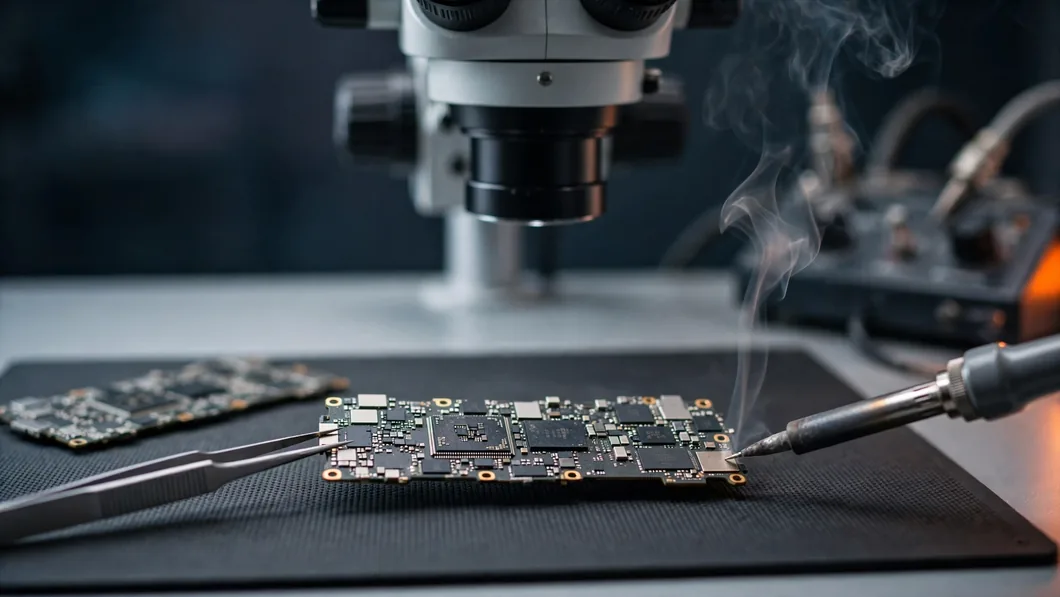
Chip-off recovery is the gold standard on flash media — USB sticks, SD and microSD cards, dashcams and voice recorders — because those chips carry no lock of their own; on phones we use board repair or a donor-board transplant (processor + memory together) instead. Software-based recovery requires a functioning phone; board-level repair requires salvageable components. On a phone, an intact NAND flash memory chip is only half of what recovery needs: the key that unscrambles it is fused into the application processor — the phone's main chip — so the pair has to travel together, which is why we repair the original board or transplant processor, NAND and EEPROM onto a donor.
Here’s what makes eProvided’s approach different from the repair shop down the street: we are not trying to give you a working phone back — we repair the board only as far as it takes to get one clean copy of your data off it. When a device does call for chip-off — flash media such as USB sticks, SD and microSD cards — our engineers desolder the NAND chip at precisely controlled temperatures (typically between 250–350°C depending on the package type), clean the chip’s contact pads, and place it into a custom socket reader. The reader performs a complete binary dump of the chip’s contents — every bit of data, including “deleted” files that haven’t been overwritten.
From there, our proprietary reconstruction software reassembles the raw data into a usable file system. Photos, videos, documents, app data — the files that are still readable come back. For context, this is the chip-off process eProvided uses on USB drives and SD cards; SSDs get original-controller revival instead. The bench equipment is the same; what changes is where the key lives — nowhere at all on a USB drive or SD card, inside the controller on an SSD, inside the processor on a phone.
Can You Recover Data from a Water-Damaged Cell Phone?
Yes — eProvided recovers data from water-damaged cell phones with a success rate that consistently exceeds 90% for saltwater and freshwater cases when devices are submitted promptly. The key factor is time: corrosion begins within hours of water exposure and progressively damages the circuit board traces and solder connections. However, the NAND flash chip itself is remarkably water-resistant due to its sealed package construction.
We’ve recovered data from phones submerged in swimming pools for days, dropped in oceans on vacation (Hawaii and the Caribbean are popular culprits), and even a phone that spent three weeks at the bottom of a lake. The phone dried in rice for a week is harder to recover than the one shipped still wet — rice does nothing to stop corrosion; the delay lets it spread. If you need to chat before shipping, you can start a live chat with our team.
Our water damage recovery process includes ultrasonic cleaning of the logic board, microscopic inspection for corrosion hotspots, and — when the board is too damaged to repair — moving the phone's original processor, memory and EEPROM together onto a matched donor board, since they only unlock the data as a set. This multi-path approach is why eProvided averages a 98% success rate even on cases other labs have declared unrecoverable. For related storage device issues caused by water exposure, see our recovering data from SD cards service. The same lab also handles flash storage of every other kind, which is why a wet phone and its wet memory card can travel in one box, and our recovering data from USB drives page covers the sticks.
Broken Phone Data Recovery — Getting Pictures Off a Dead Phone
 Enlarge
Broken phone data recovery is the single most common request we get: the screen is black, the body is bent, the phone is dead — and the pictures matter more than the device. The answer is almost always good news: professional broken phone data recovery does not need the phone to switch on for you — only for us, and only for a few minutes. Your photos live on the NAND chip, not the screen or battery — we recover data from a broken phone by reading that chip and returning your files on a USB drive or secure download.
Can you retrieve pictures from a broken phone?
Yes. Pictures can be retrieved from a broken phone in the vast majority of cases — even when it won’t turn on or the screen is shattered. The camera roll lives on the NAND memory chip, which usually survives the damage that killed the phone. We get the phone reading again, rebuild the photo library, and deliver it organized by folder — the same recovering photos and video files process we use for corrupted SD and memory cards. Typical turnaround is 1–3 business days.
How to get pictures off a broken phone
First, stop charging it — power cycles on damaged boards cause more harm. If the screen is dead but the phone vibrates, broken phone data recovery odds are excellent. Ship the phone to our lab via the free evaluation form; we diagnose within 24 hours of arrival and quote before any work begins. Need texts too? We also recover deleted text messages as part of most phone jobs.
Android Phone Data Recovery Service — Samsung, Pixel & More
eProvided’s Android phone data recovery service covers every major brand — Samsung Galaxy, Google Pixel, OnePlus, Motorola, LG, Sony, Xiaomi, and budget Android handsets alike. Our Android process is not brand-agnostic: a dead Samsung and a dead Pixel scramble their NAND flash with keys held in different processors, so we match the board-level approach to the exact model before anything is touched. If the memory chip survived, your photos, messages, and contacts almost certainly did too.
Android data recovery does carry one wrinkle iPhones don’t: fragmentation across manufacturers and storage controllers. A Samsung Galaxy uses different NAND packaging and encryption handling than a Pixel or a Motorola, so our engineers match the read profile to the exact model. Common Android cases we handle every week run the full range: a dead Samsung Galaxy, Pixel, or OnePlus with a failed board and a black screen that won’t turn on; a phone bricked by a failed update — corrupted Android 14 or 15 firmware, or an OTA that got interrupted partway through; a cracked, bent, or liquid-damaged handset; and the boot-loop or “encryption unsuccessful” message where the phone restarts forever or simply refuses to decrypt. We also recover deleted photos and messages after an accidental erase or factory reset on a working Android, and we handle the damaged microSD card many Android phones use for photo storage.
For severely damaged Android devices we rebuild a working path through the phone's own silicon — repairing the board, or transplanting processor, NAND and EEPROM to a donor — the same method described in NIST SP 800-101 for forensic mobile acquisition. Whether your Samsung went through the wash or your Pixel won’t boot after an update, start a free evaluation and we’ll tell you exactly what’s recoverable before any work begins.
What Has eProvided Recovered for Government Agencies?
eProvided is a registered federal vendor that has worked directly with NASA across four centers — Goddard, Johnson, the Jet Propulsion Laboratory, and Langley — on data recovery and storage-failure consulting spanning more than two decades. Our founder, Bruce Cullen, personally handled the NASA Helios mission recovery in 2003, extracting flight data from an unmanned solar-powered aircraft that crashed into the Pacific Ocean and sat submerged in saltwater for over 60 days — a recovery Bruce later described in writing directly to a NASA Special Agent, who did not dispute the claim.
JPL engaged eProvided as a paid vendor for a separate hard-drive recovery (Pasadena facility) and consulted with our team on failure-mode analysis for the Low-Density Supersonic Decelerator Mars program. We’ve also been contacted regarding Mars rover mission hardware. Beyond NASA, eProvided’s government and defense footprint includes the U.S. Army, the U.S. Navy (including the Naval Research Laboratory), the U.S. Space Force, the National Geospatial-Intelligence Agency, and civilian federal agencies including the FAA, CDC, USGS, and NIH — more than 70 government and military cases in total, plus data recovery work for nearly 500 universities and research institutions.
That mission-critical track record is directly relevant to cell phone data recovery: the same saltwater and corrosion work that pulled flight data off a submerged aircraft for NASA is what we bring to your iPhone when it falls in the ocean or your Samsung Galaxy goes through the wash — on a phone that work happens on the board, because the files are locked to the processor. When agencies with billion-dollar budgets and zero tolerance for data loss need their data back, they call eProvided.
Broken or Water-Damaged Phone?
Ship it to our lab for a free evaluation. We recover data from phones other companies turn away.
Get My Free EvaluationHow Much Does Cell Phone Data Recovery Cost?
Cell phone data recovery costs vary based on the type and severity of damage, but eProvided provides a free evaluation and upfront pricing before any work begins. There are no hidden fees and no surprises. Simple logical recoveries (deleted files from a working phone) start at a lower tier, while complex board repairs and donor-board transplants on severely damaged devices cost more due to the specialized equipment and time required.
Our pricing promise: No Data, No Data Recovery Fee. If we cannot retrieve your files, you pay nothing — so we only take on cases where we believe recovery is likely. For specifics, visit our cost and pricing details for general ranges, because the real figure depends on what the lab finds inside your phone. For a personalized quote, a free evaluation comes first and costs nothing.
Cell Phone Data Recovery Checklist
| Scenario | Recoverable? | Recovery Method |
|---|---|---|
| Cracked screen, phone still vibrates | Very likely | Board-level repair on the original board |
| Water damage, sent within 48 hours | Very likely | Corrosion cleaning, then board repair or donor transplant |
| Won’t power on, no visible damage | Very likely | Board repair — power and charging circuit first |
| Fire-damaged, screen melted | Likely | Board repair, else donor transplant of processor + NAND + EEPROM |
| Factory reset, phone used since | Partial | NAND deep scan (overwritten data may be lost) |
| Bricked by failed update | Very likely | Firmware repair on the phone’s own board |
Emergency Phone Data Transfer Service — Rush Recovery
When your phone fails at the worst possible moment — right before a device upgrade, during a legal matter, or in the middle of a family emergency — eProvided offers rush data recovery and our emergency phone data transfer service to get your files back fast. Standard turnaround is 1–3 business days, but rush cases are moved to the front of the line ahead of all current cases, so your recovery begins the moment your device arrives at our Las Vegas lab.
We transfer recovered data directly to a USB drive, secure cloud link, or new device — whichever is fastest. To request rush service, call (866) 857-5950 or mention it on your free evaluation form. Rush pricing is quoted upfront, and the guarantee still applies on emergency cases.
Cell Phone Data Recovery Near Me — One Las Vegas Lab, Worldwide Reach
Searching for “cell phone data recovery near me” and coming up short? You don’t need a recovery lab in your city — eProvided serves all 50 states through secure, insured shipping to our Las Vegas lab. The phone in your hand is the only thing that has to travel, and a small padded box gets it to our Las Vegas lab overnight from anywhere in the country. Local repair shops send their toughest board-level cases to specialists like us anyway; mailing it in skips the middleman and the markup.
We recover cell phone and iPhone data for customers in every state — including high-volume regions like Texas, California, Florida, New York, Arizona, Georgia, New Mexico, and Minnesota — with the same 98% success rate and the same No Data, No Data Recovery Fee guarantee no matter where the package ships from. Shipping your device works the same from any location: complete the free evaluation form online in about two minutes, no phone call required, then bubble-wrap the device in a small box and send it to our lab — ship a wet phone wet, not dried in rice. We evaluate on arrival and quote upfront before any work begins, usually within 24 hours, and you can follow your case through our online tracking system from anywhere in the country. Once recovery is complete, your files come back on a new USB drive or secure download, delivered straight to your door.
Because every recovery happens at one accredited lab rather than a franchise counter, you get a senior board-level engineer on your case regardless of your zip code. Prefer to ask first? Call 1-866-857-5950 — we’ll walk you through shipping from your state.
How to Get Started with Cell Phone Data Recovery
Getting started is simple and takes less than two minutes, and you can track your case status in real time through our online tracking system.
- Free Evaluation — visit our recovery form, describe your device and the issue, and pack the phone securely (bubble wrap in a small box works great) before shipping it to our Las Vegas lab.
- Microscope Inspection — diagnosis is completed within 24 hours of arrival, as our engineers inspect the device under high-powered microscopes to identify the failure point and choose the extraction method.
- Board-Level Recovery — repairing the original board under a microscope, or moving the original processor, NAND and EEPROM together onto a matched donor board, until the device gives up one clean copy of the data.
- File System Reconstruction — once that copy exists, we rebuild the file system from the raw dump, recovering photos, videos, contacts, messages, and app data.
- Secure Delivery — your recovered files return on a USB drive, secure cloud link, or new device, with the data on our servers permanently deleted after you confirm receipt.
If your situation is urgent, call us toll-free at 1-866-857-5950 to arrange rush service. eProvided averages a 98% success rate across all cell phone recovery cases — and we’ve been doing this since before the first iPhone existed. Your data is in experienced hands.
Real Phone Cases From Our Records
Four phones that reached the lab, in the customers’ own words from the evaluation form, with what the lab’s notes record. One came back, one did not, and two customers declined the quote after the evaluation. The IDs and dates are real, the names are withheld, and no prices appear here.
iPhone 5 broken into pieces, June 2026
“iphone 5 broken apart (separated/pieces) but still has major parts and a some sort of card. I just want pictures.”
Case K97HJY, June 2026. Recovered. The customer approved an advanced recovery on July 8, and the lab’s note on August 3, 2026 records a success.
iPhone 13 Mini that died overnight on the charger, July 2026
“At night I put on the charger and in the morning the phone was dead. Pushing the start button the apple logo appears for about 30 seconds then the phone goes dead.”
Case ZYB83X, July 2026. Not recovered. The customer approved an advanced recovery, and the lab’s note on August 11, 2026 says that despite extensive work at the board and component level the data could not be recovered, because the processor itself had suffered permanent internal damage. Some phones cannot be saved, and we tell the customer plainly.
iPhone that would not turn on, January 2026
“iPhone won’t turn on. We would like the photos off of the phone.”
Case ADAR9A, January 2026. No recovery attempted. The lab quoted the work needed, the customer declined it on January 29, 2026, and the phone went back.
iPhone 4 that had been through a washing machine, October 2025
“iPhone 4 went through washer several years ago. The phone was never restored/wiped, but it stays stuck in recovery mode likely due to NAND failure.”
Case 84P6VA, October 2025. No recovery attempted. The customer approved an advanced recovery, then declined the quote on November 3, 2025 and had the phone returned.
What Our Customers Say
Read verified reviews on Trustpilot or join the conversation on our Reddit community.
Frequently Asked Questions: Cell Phone Data Recovery
How Long Does Cell Phone Data Recovery Take?
Most cell phone data recoveries are completed within 1 to 3 business days after we receive your device. Rush service moves urgent cases — legal evidence, missing-persons investigations — to the front of the queue. The timeline depends on damage severity and extraction method: a straightforward board repair takes less time than a donor-board transplant followed by extraction.
Can You Recover Data from a Phone That Won’t Turn On?
Yes — a phone that won’t power on is one of the most common cases we handle. The NAND flash memory chip survives the screen and the battery, but it is locked to the phone's processor — the main chip the encryption key is fused into — so our process repairs the board, or moves that processor, the NAND and the EEPROM together onto a donor board. We recover photos, videos, text messages, contacts, and app data from completely dead devices every day.
What Types of Data Can You Recover from a Damaged Cell Phone?
Virtually everything: photos, videos, contacts, SMS and iMessage, WhatsApp conversations, call logs, app data, documents, notes, voicemails, browser history, and email attachments. What comes back depends on the damage; the free evaluation tells you what is recoverable.
Do You Recover Data from Both iPhones and Android Phones?
eProvided recovers data from all smartphone brands and operating systems, including Apple iPhones (every model from iPhone 5 through iPhone 16 Pro Max), Samsung Galaxy devices, Google Pixel phones, OnePlus, Motorola, LG, and more. Both iOS and Android devices store files on NAND flash memory and lock them to the phone's processor, so on all of them our work is board-level — repair first, donor transplant second. For model-specific information, see our dedicated recovery pages for iPhone 16 Pro Max and Samsung Galaxy S24 Ultra.
Is My Personal Data Kept Private During Recovery?
Absolutely. All recovered data is encrypted during extraction, stored on secure servers, and permanently deleted after you confirm receipt. We handle government-classified data for agencies like the FBI and Department of the Navy — the same security standards protect your personal files, and we never access or share your data beyond what the recovery requires.
What Should I Do Immediately After My Phone Is Damaged?
Power off the device immediately — do not charge it, restart it, or connect it to a computer. For water damage, skip the rice myth; place the phone in a dry container and contact eProvided fast. The sooner we receive the device, the higher the recovery success rate — corrosion progresses hourly.
How Is Board-Level Recovery Different from Software Recovery Tools?
Software recovery tools require a phone that powers on and connects to a computer — they only recover deleted files from a functional device. Hardware recovery works on a phone in any condition because we work on the board itself — and on phones the memory chip is never read outside the phone on its own, since the key that unscrambles it lives in the processor. If your phone still powers on and mounts as a drive, it's worth trying free file recovery software first — board-level recovery is for when that's not an option.
What can iPhone data recovery actually retrieve from a damaged device?
The short answer: photos and videos from the camera roll, iMessages and texts, contacts, voice memos, notes, calendar entries, and app data. iPhone data recovery works even when the phone won't turn on, has been sitting in salt water for a week, or the screen is too smashed to swipe. Our iPhone data recovery process gets the phone's own hardware running long enough to copy the filesystem out intact — when the iPhone data recovery job is finished you get an external drive back, organized in folders that look like the phone you remember.
How is iPhone data recovery different from Android data recovery?
One word: encryption. Every file on an iPhone since the 3GS in 2009 is scrambled with a key derived from a 256-bit ID fused into the application processor — the phone’s main chip — so a chip-off pull of the NAND alone returns encrypted blocks. Our iPhone data recovery process never separates that pair: we repair the original board, or move the application processor, the NAND and the EEPROM onto a matched donor board together — which is why most labs that can touch Android give up on iPhones.
Model-Specific Cell Phone Recovery Services
 Enlarge
eProvided offers dedicated recovery services for the most popular smartphone models, each with device-specific expertise and optimized recovery procedures: From flagship models to older devices no longer sold new, our recovery team has built dedicated procedures for each major smartphone line. Whether your device suffered water damage, a cracked logic board, or a failed NAND chip, we match the extraction method to the exact hardware — a Samsung Exynos chip and an Apple A-series chip require different tools and different techniques. Below, each card links to a dedicated page covering that model’s common failure points, typical turnaround, and what to expect from our free evaluation process. Newer flagships add another wrinkle: tighter internal tolerances, adhesive-sealed batteries, and in Apple's case, an encryption key fused into the application processor since 2009, which is why an iPhone's processor and memory have to stay together, all of which change how carefully a technician has to work before the chip ever comes off the board. That’s why we keep a separate procedure on file for each current model rather than a single generic phone-recovery workflow.
- iPhone 15 Pro Max — A17 Pro board-level recovery
- iPhone 16 Pro Max — Latest Apple silicon recovery techniques
- iPhone Air — Ultra-thin device board specialists for dead or dropped phones
- iPhone 13 — A15 Bionic board-level recovery for dead or wet phones
- Samsung Galaxy S24 Ultra — Snapdragon & Exynos board-level recovery
- Water-Damaged Phone — Wet, dropped & submerged phones
- Locked Phone Recovery — Forgotten passcode & locked devices
- NAND Flash Recovery — How we recover USB sticks, SD cards and other flash media
Don’t see your model listed? We recover data from every smartphone ever made — including older models, flip phones, and devices from manufacturers no longer in business. Whatever it stores data on, we will tell you free whether we can get it back, and how. For locked devices, see our dedicated locked phone data recovery service.
Further Reading: iPhone & Mobile Recovery Guides
- Everything about iPhone data recovery — a complete guide
- When your iPhone won’t turn on — recovering data from a dead iPhone
- When your iPad breaks and you need the data
- The dangers of cell phone memory add-ons
Ready to Get Your Phone’s Data Back?
Since 1999 — 27+ years of cell phone data recovery. 98% success rate.
Start My Phone Data Recovery EvaluationPrefer to talk it through first? Call (866) 857-5950 — our lab is at 9527 Knopfler Ln, Las Vegas, NV 89148.
Related Recovery Services
More recovery services for other device and media types: