Data Recovery Company · Since 1999 · Worldwide
About eProvided — The Data Recovery Company Used by NASA, the FBI & the U.S. Navy
Who Is eProvided?
eProvided is a data recovery lab founded in 1999 and run by Bruce Cullen from Las Vegas. The work is chip-level: reading NAND memory and drive components directly when a device is dead, flooded or smashed. Used by NASA, the FBI and the U.S. Dept of the Navy.
“The jobs that reach us are usually the ones another lab already handed back. That was true in 1999 and it is still the whole business.” — Bruce Cullen, founder, eProvided
eProvided is a data recovery company founded in Las Vegas in 1999 that retrieves lost files from failed hard drives, SSDs, USB flash drives, memory cards, and phones — worldwide, across every major class of computer data storage device. We specialize in chip-level recovery: reading data directly off NAND and monolithic chips when controllers die and software gives up. Every case starts with a free evaluation. Call 1-866-857-5950 or start your free evaluation.
Our Story — Recovering Data Since 1999
 Enlarge
eProvided was founded in 1999 by Bruce Cullen, after he kept watching people lose data they believed was gone for good — family photos, business records, a lifetime of files — when, in most cases, it wasn’t actually gone at all. That realization became the company’s mission: when a drive dies, the data usually survives in the silicon, and the job is to go in and get it back. More than 27 years later, that mission has not changed.
From the beginning, eProvided was built around one engineer’s bench rather than a sales floor. Bruce ran the recoveries himself, learned each new failure mode as storage technology shifted from spinning platters to flash, and developed in-house techniques for reading NAND and monolithic chips directly. As consumer storage moved to USB sticks, SD cards, SSDs, and phones, that deep hardware focus became the company’s defining strength — the work most labs send away, eProvided does on-site. The rule at that bench has never changed: never make a faint thing worse. It is the same rule the park teaches at the Reef Bay petroglyphs on St. John, the carvings behind our mark.
 Enlarge
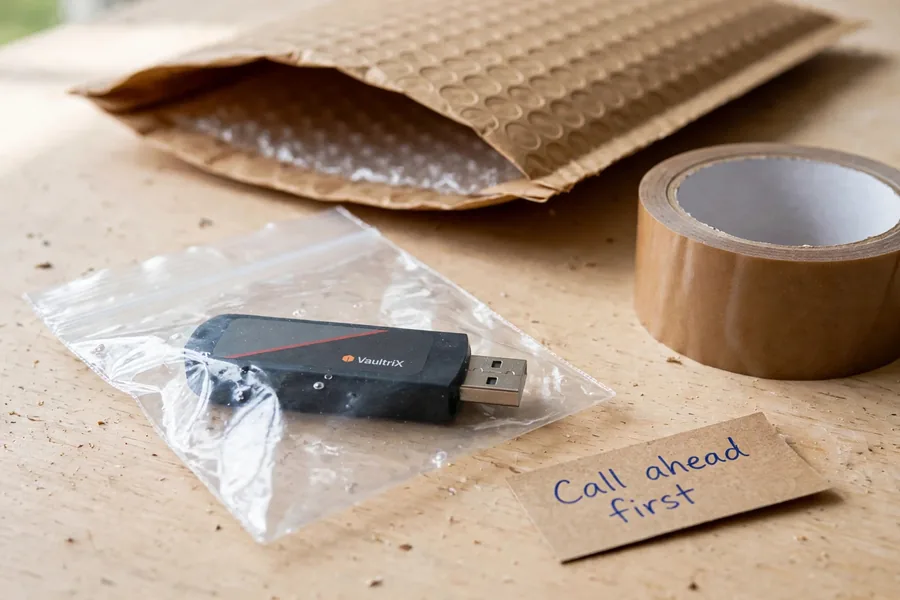
Our Las Vegas lab is based in Las Vegas, Nevada, but the work is worldwide. Customers ship failed drives, phones, and memory cards from across the globe every day, and the process is the same for everyone: a free evaluation first, an honest answer about what is recoverable, and a firm quote before any work begins. Across 27+ years the bench has handled tens of thousands of cases — from a single water-damaged phone to enterprise arrays — at a 98% success rate. Local customers can also drop a device off in person, by appointment, at the lab on Knopfler Lane. Pack the device in a small plastic bag inside a padded mailer or box so nothing can shift or rub in transit; the shipping instructions we send give the rest. Tell us on the evaluation form what happened and what you already tried, because that detail often decides which route we take before the device even arrives, and it is the one thing a customer can do to speed the diagnosis. Wherever the device starts, you can begin the same way every one of those customers did, with a free evaluation.
eProvided at a Glance
Readers who check a lab before sending a device want the checkable facts first. This table collects them in one place, and every row matches what the rest of this page says.
| eProvided Data Recovery, Key Facts | |
|---|---|
| Item | Detail |
| Founded | 1999, in Las Vegas, Nevada, by Bruce Cullen |
| Who runs the lab | Bruce Cullen, Founder & Certified Data Recovery Specialist, on the bench since day one |
| Lab address | 9527 Knopfler Ln, Las Vegas, NV 89148. Drop-off is by appointment, so call ahead |
| Phone | 1-866-857-5950 |
| Who we serve | Customers worldwide. Ship in with any carrier, or visit the Las Vegas lab by appointment |
| Core skill | Chip-level recovery on USB flash drives, SD and microSD cards, SSDs and phones, plus hard drives, RAID and optical discs |
| Success rate | 98% |
| Independent standing | BBB A+ rating; 4.9 out of 5 from 67 verified reviews on Trustpilot; featured in Popular Mechanics (2005), where the printed page is shown further down, and in Reuters |
| Before any work | Free evaluation and a firm written quote |
What We Recover
 Enlarge
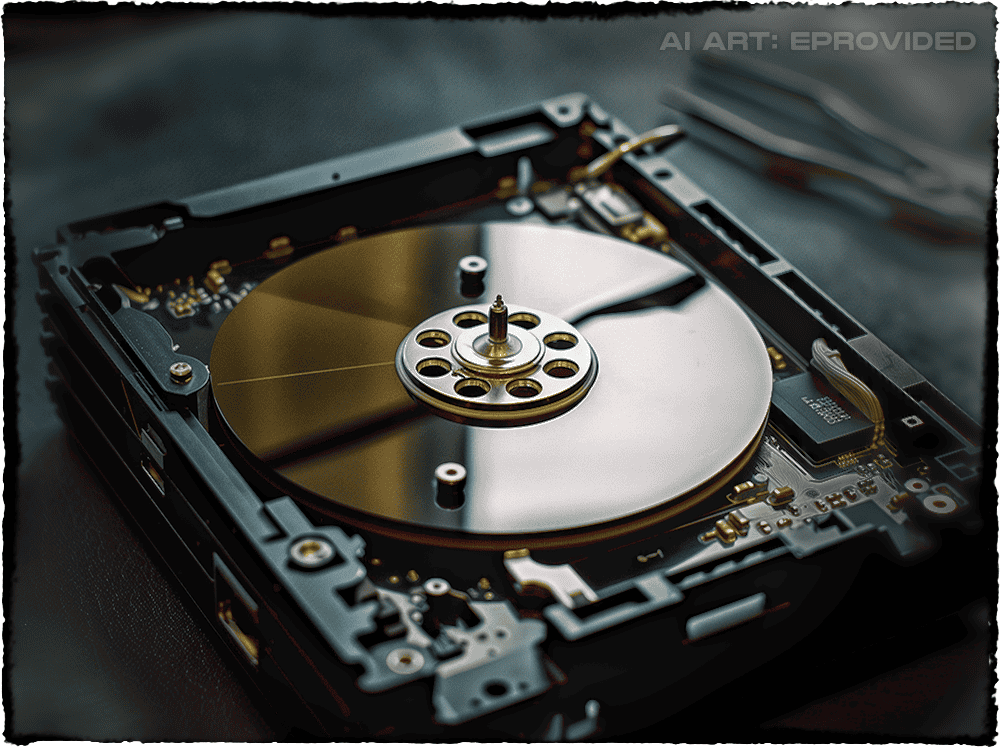
If it stores data and it has failed, eProvided most likely recovers it. Over 27+ years the lab has worked across every major storage class, every common file system, and effectively every brand on the market, including Kingston, SanDisk, Samsung, Seagate, Western Digital, and PNY. The goal is always the same regardless of the device: return your files in their original structure. The table below shows each device family, the usual failure, and the route the lab takes.
Across those families we handle any file system — Windows NTFS and FAT, Mac, and Linux — and any failure type, from boot failure and corrupted partitions to physical, water, and fire damage, on devices ranging from a 1GB thumb drive to multi-terabyte arrays. A file system is only the index to your files, and it is usually the index that breaks first: a power cut during a write, a rushed unplug, or a controller fault can leave the table unreadable while the files themselves are untouched. We rebuild that index from the raw data, so folder names and dates come back with the files instead of as a pile of numbered fragments.
| Device Families, Usual Failures and the Lab’s Route | ||
|---|---|---|
| Device | What usually went wrong | How the lab approaches it |
| Hard drives | Clicking, dropped, dead, fire- or water-damaged mechanical drives | Head swaps and platter work in the dedicated hard drive lab |
| SSDs, M.2 and NVMe | Failed controller, NAND wear, firmware corruption | We identify the controller first. Then we repair the original board, move controller and memory together to a donor, or read the NAND directly and descramble it when the controller does not encrypt. A result is never promised |
| USB flash drives | Snapped plug, dead controller, monolithic chips, water | Chip-off extraction, or reading the NAND through test points on monolithic drives |
| SD, microSD and other cards | Cracked, corrupted or water-damaged cards, SD, microSD, CompactFlash, Memory Stick, SmartMedia | Direct NAND access past the dead controller, then descrambling and error correction |
| Phones and tablets | Water, crushed boards, boot loops on iPhone, Samsung Galaxy, Google Pixel and other Android phones | Board-level repair on the original board, or a donor-board transplant. Modern phones tie the key to the processor, so a bare memory-chip read does not help |
| CDs and DVDs | Scratched, peeling or unreadable optical discs | Professional resurfacing, then slow, multi-pass, error-corrected reads |
| RAID and servers | Failed members, rebuild errors, controller loss | Read each member drive and rebuild the array from the images |
It is worth being clear about what “failed” usually means, because customers often arrive convinced the situation is worse than it is. A drive that no longer appears on your computer, a card that prompts you to format it, a phone stuck on a boot loop, a USB stick that reads as empty — in the large majority of these cases the underlying data is still physically present. What has broken is the path to it: a controller, a connector, a firmware module, a partition table, or a file-system header. Our job is to restore that path, or bypass it entirely, without ever writing to the original media. That non-destructive, evaluate-first approach is why we can quote honestly before any work begins, and why a “dead” device is so often recoverable.
Lost important data? We can get it back.
Free evaluation on every case • firm quote before any work • recovering data since 1999.
Start My Free EvaluationOr call (866) 857-5950
NAND Flash Recovery Expertise
 Enlarge
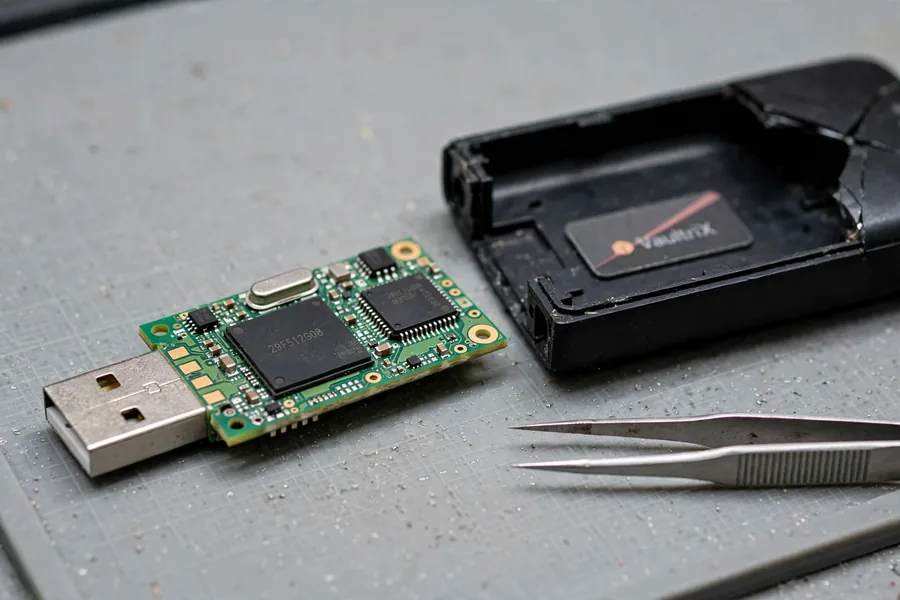
What sets eProvided apart from a general repair shop is chip-level recovery. When a USB drive or memory card fails, the controller that translates between your computer and the raw flash is often what dies — while the data still sits intact in the NAND cells underneath. Recovering it means bypassing the dead controller entirely and reading the silicon directly, a discipline most labs send out rather than perform in-house.
That work begins with chip-off extraction: engineers desolder or lift the NAND chips from the board using precision rework stations, then mount them on adapter boards. From there a dedicated NAND programmer captures a full bit-for-bit image of each chip. For monolithic devices — budget USB sticks and microSD cards where the controller and flash are fused into a single epoxy block with no test points — recovery requires grinding to expose substrate contacts and probing them by hand. It is the most demanding class of flash recovery, and it is routine work here.
A raw NAND dump is not yet readable data. The controller scrambles user data with XOR operations, ECC, and vendor-specific encoding, all of which must be decoded before anything resembling a file appears. eProvided rebuilds the flash translation layer (FTL) from raw dumps, unscrambles the encoding for the major controller families, reassembles interleaved multi-chip images, and then runs file-system analysis to restore folders, photos, and documents in their original structure. This is exactly the kind of recovery consumer recovery software cannot perform: software assumes a working controller and a readable file system, and chip-level cases have neither. Our deepest reference page on this work is NAND flash data recovery.
One exception matters, and we say it up front. Some devices, including modern phones and some SSDs and high-speed cards, encrypt data with a key held in the controller or processor. A bare chip read of those returns scrambled data, so the honest routes are repairing the original board or moving the processor and memory together to a donor. We tell you which route applies to your device before any work starts.
Who Trusts eProvided
 Enlarge
The same chip-level capability that recovers a customer’s wedding photos has been called on for some of the most difficult recoveries imaginable. eProvided’s work has been used by NASA, the FBI, and the U.S. Department of the Navy, and reaches across the Department of Defense. The NASA Helios Prototype solar-electric aircraft broke up in flight and fell into the Pacific on June 26, 2003; Bruce personally recovered the mission’s environmental data from a saltwater-corroded CompactFlash card, a card he still keeps in his office today. eProvided also recovered pre-launch data for NASA’s DAVINCI Venus mission from a hard drive.
The NASA work goes beyond recovery. NASA has also called founder Bruce Cullen directly regarding a NAND data-transmission glitch on the Mars rover, a case that made national news, and eProvided was also contacted about data storage for the Nancy Grace Roman Space Telescope program. eProvided has also consulted with NASA’s Jet Propulsion Laboratory on data-recovery planning and storage failure modes for Mars-technology programs. The engineering used on a federal recovery is the engineering applied to a snapped USB drive on the bench the next morning.
That track record is matched by independent standing. eProvided holds a BBB A+ rating, carries a 4.9/5 rating from 67 verified reviews on Trustpilot, and has been featured in Popular Mechanics (2005) and Reuters. Retail chains, computer-repair franchises, and enterprise IT departments quietly route their hardest cases here as well — the recoveries other labs decline often arrive at this bench second.
Our own customer case records show completed jobs for people at the organizations below. The list shows completed work, not a partnership or an endorsement, and it names only organizations whose jobs were finished and returned.
| Organizations We Have Recovered Data For | |
|---|---|
| Group | Organizations |
| Aerospace and federal | NASA, including JPL, the FBI, the CDC, the FAA, the National Park Service |
| Military | U.S. Army (including a deployed unit), U.S. Navy, Naval Research Laboratory, U.S. Coast Guard, Peterson Air Force Base |
| Corporate | IBM, GE, HP, Raytheon, Honeywell, Ford, Cisco, JPMorgan Chase |
| Universities | MIT, Harvard, Stanford, the University of Michigan, and many more |
Talk to the engineer who does the recovery.
27+ years of chip-level expertise • free, no-obligation evaluation • honest answers.
Start My Free EvaluationOr call (866) 857-5950
About Our Founder, Bruce Cullen
 Enlarge
Bruce Cullen founded eProvided in Las Vegas in 1999 and has personally run the lab ever since — a Certified Data Recovery Specialist whose bench has handled tens of thousands of failed drives, chips, and cards across 27+ years. The federal and aerospace work is set out in Who Trusts eProvided, and his full story, with dated cases, is on the founder profile.
What that means for you is simple: there are no middlemen and no outsourcing. The person who pioneered the lab’s NAND-reading techniques is the same person who evaluates your device, performs the recovery, and answers your questions along the way. That continuity is rare in this industry, where most intake desks hand work off to a separate facility you never speak to.
Bruce’s view of the work has stayed consistent for more than two decades: storage fails, but data is resilient, and the difference between “gone” and “recovered” is almost always expertise rather than luck. His short lessons from the bench are collected in Top 5 Quotes From Bruce Cullen. Featured in Popular Mechanics (2005) and Reuters, eProvided holds a BBB A+ rating.
Our Guarantee & Process
 Enlarge
Every eProvided recovery is built around a few straightforward promises, and the process is designed to keep you in control from the first day to the last. We diagnose your device at no cost as soon as it arrives, identify the failure mode, and tell you honestly what is recoverable before you commit to anything. If we cannot recover your data, you owe no recovery fee — our No Data, No Data Recovery Fee promise. Standard cases run a few business days from receipt, with rush and 24/7 emergency options when time is critical. Wherever you are, you can ship in from anywhere using any carrier; local Las Vegas customers are also welcome to drop devices off in person by calling ahead to confirm a scheduled arrival time, with every case tracked the same way regardless of how it arrived.
Behind those promises is a deliberately simple workflow. You submit a short evaluation form, ship the device, and we diagnose it on arrival. We then send you a plain-language assessment and a firm quote up front — no surprise charges later, and no pressure to proceed. If you approve, we recover the data, send a complete file listing for your review, and only then return your files on fresh encrypted media or by secure download. Your original device comes back too. At every step the data stays under our control and is never shared, which is the same standard that lets sensitive and government cases flow through the same lab. The data recovery process page walks through each stage in more detail.
| How a Case Works, Step by Step | ||
|---|---|---|
| Step | What happens | What you get |
| 1 | You submit the short evaluation form and ship the device, or arrange a Las Vegas drop-off | Shipping instructions right away |
| 2 | We diagnose the device on arrival, with no work on the original media until you agree | A plain-language assessment of what is recoverable |
| 3 | You review the quote | A firm price, with no obligation to proceed |
| 4 | We recover the data and list the files found | A complete file listing to approve before you pay |
| 5 | We return your files | Fresh encrypted media or secure download, plus your original device |
That combination — a free look, a no-recovery-no-fee promise, and the same chain-of-custody care used on sensitive cases — is what lets customers send irreplaceable data to a lab they have never visited. When you are ready, begin your case now and we will send shipping instructions right away.
Careers & Internships — eProvided Is Hiring Las Vegas Interns
Now Hiring · Las Vegas Internship
We're looking for enthusiastic Las Vegas locals to join our team at a global data recovery leader. It's real, mentored experience working directly alongside our engineers and marketing team. Students and early-career applicants are welcome to apply across these areas:
Text 714-225-9700 · Email your resume to contact@eprovided.com
Apply for the AI & Tech InternshipWhat Our Customers Say
eProvided reviews from past customers consistently highlight the same things: data recovered after other shops gave up, and clear communication from start to finish. Every review below is public on Trustpilot, where you can check the wording and the date.
About eProvided — Frequently Asked Questions
Q: How long has eProvided been in business?
eProvided has been recovering data since 1999 — that’s 27+ years of hands-on experience. Founder Bruce Cullen started the company that year and still runs the lab today, so every case benefits from more than two and a half decades of chip-level recovery work rather than a rotating help desk.
Q: Where is eProvided located, and do you serve my area?
Our lab is at 9527 Knopfler Ln, Las Vegas, NV 89148 — see our Las Vegas data recovery page for local drop-off details. Local customers are welcome to drop devices off in person by calling ahead to confirm a scheduled arrival time, and we serve clients worldwide by shipping it to our lab — people ship us failed drives, phones, and memory cards from across the globe every day using any carrier.
Q: What does eProvided actually specialize in?
Chip-level recovery, explained under NAND Flash Recovery Expertise. The same bench also handles mechanical hard drives, RAID, and effectively every common file system and brand.
Q: Is there a fee if you can’t recover my data?
No. Our policy is No Data, No Data Recovery Fee — if we can’t recover your data, you owe no recovery fee. Every device first gets a Free Evaluation, so we diagnose the problem and quote the cost before any work begins, with no obligation to proceed.
Q: Who uses eProvided?
Everyone from individuals with one irreplaceable photo to businesses and IT departments. Our work has also been used by NASA, the FBI, and the U.S. Department of the Navy, and we hold a BBB A+ rating — but the same expert process backs every case, large or small.
Q: How do I start a recovery?
Submit a free evaluation form describing your device and what happened; it takes about two minutes and we send shipping instructions immediately. Pack the device, mail it from anywhere, and we diagnose it on arrival. You approve a full file list before paying anything.
Q: Can I check eProvided’s reviews and ratings myself?
Yes. The 4.9 out of 5 rating comes from 67 verified reviews on Trustpilot, which anyone can open and read in full. The BBB A+ rating and the 2005 Popular Mechanics feature are also public, and the printed scan appears under Who Trusts eProvided.
Q: Can eProvided recover a phone or an encrypted SSD?
Often yes, by a different route than a USB stick. Modern phones and many SSDs tie the encryption key to the controller or processor, so we repair the original board or move the processor and memory together to a donor. We say which route fits before work starts. No lab can promise a result; see the SSD row in the table above for the route.
Q: How long does a recovery take?
Standard cases run a few business days from the day the device arrives. Rush and 24/7 emergency options exist when time is critical. The step table under Our Guarantee & Process lists each stage.
Q: Do I need to visit the Las Vegas lab?
No. You can ship the device with any carrier and never visit. Local customers can drop a device off in person, but only by appointment, so call 1-866-857-5950 first. Every case is logged and tracked the same way, however it arrives.
Ready to get your data back?
Free evaluation, firm quote, then recovery — recovering data since 1999.
Start My Free EvaluationOr call (866) 857-5950
Our Data Recovery Services
eProvided recovers every storage class from one Las Vegas lab. Explore our related recovery services — choose your device or open the full service hub: