
NASA · Military · Government · High-Stakes Recovery
When the Data Has to Survive What the Engineer Couldn’t Predict
What Is Mission-Critical Data Recovery?
Mission-critical recovery is where the device cannot be replaced and the data has to survive whatever destroyed it: flight recorders, spacecraft hardware, prototype storage, one-off test rigs. eProvided recovered the Helios flight data, and consults on how storage fails before a mission ever launches.
“On a mission part there is no second unit to practise on. You get one attempt, and the first move has to be the right one.” — Bruce Cullen, founder, eProvided
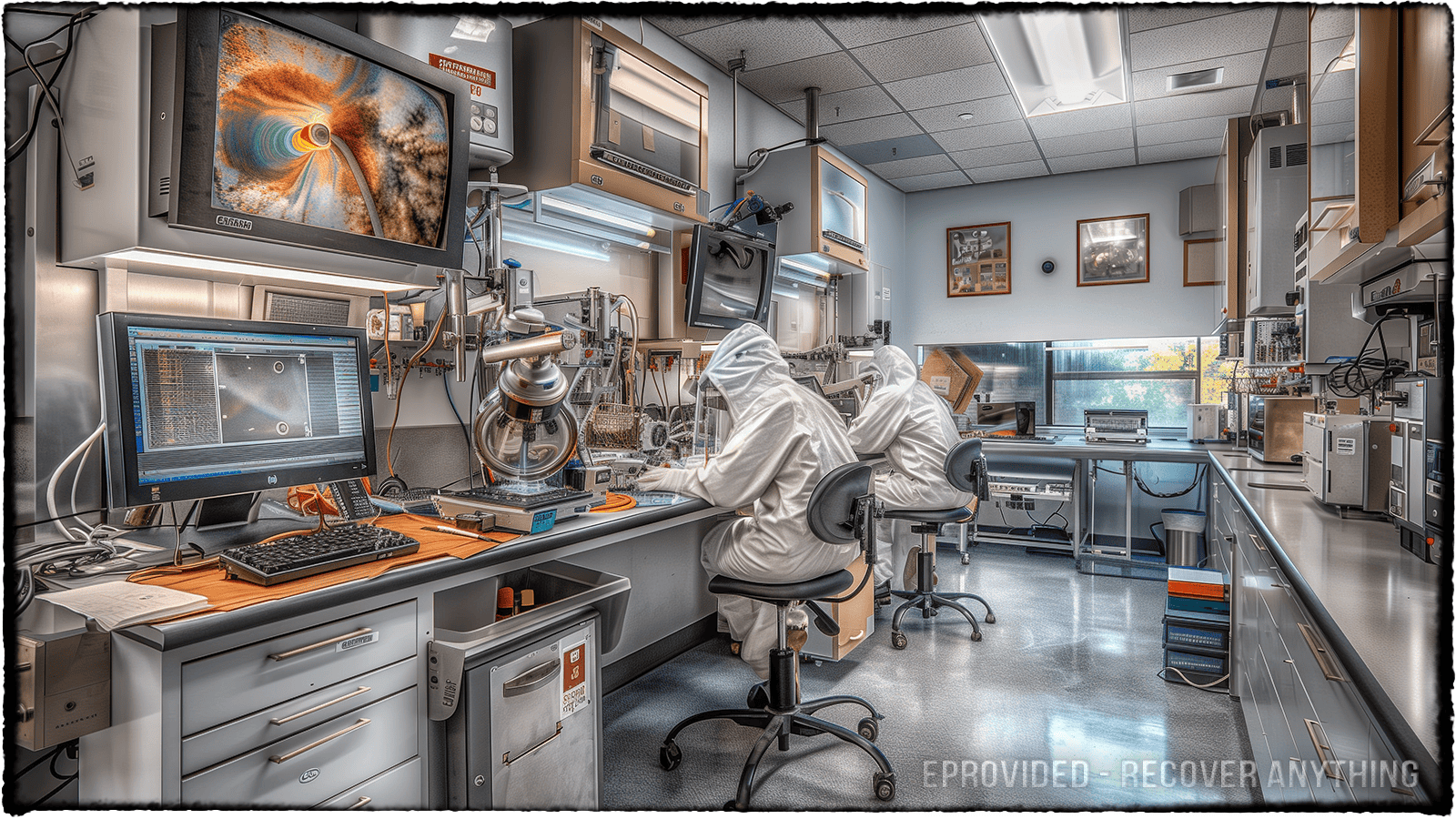
For 27 years, eProvided has recovered data from the most destroyed storage on Earth — drives pulled from saltwater, fire, high-speed crashes, and impacts that left nothing but fragments. We performed one of the earliest documented mission-critical saltwater recoveries in 2003, extracting flight data from a CompactFlash card after the NASA Helios Prototype aircraft crashed into the Pacific Ocean off Kauai. Since then, NASA centers, branches of the U.S. military, federal agencies, and hundreds of research institutions have brought us in when the data cannot be lost. We hold verified government credentials, and our No Data, No Data Recovery Fee guarantee applies to every mission-critical case we accept.
Table of Contents
- The World’s Most Complete Failure-Mode Record
- Trusted with High-Stakes Recoveries
- How We Recovered the Helios Flight Data
- What We Consult On
- Why This Matters for Space, Lunar & Mars Missions
- How an Engagement Works
- Mission-Critical Recovery vs. Standard Lab
- Why eProvided
- What Our Clients Say
- Frequently Asked Questions
- Related Recovery Services
The World’s Most Complete Failure-Mode Record

Every mission-critical recovery teaches us something new about how storage actually dies. Over 27 years we’ve logged tens of thousands of documented recovery cases and performed chip-level (chip-off) work on thousands of NAND flash chips across 800+ distinct part numbers — from every major manufacturer (Micron/Intel, Samsung, SanDisk, Toshiba/Kioxia, SK Hynix) and 600+ controller chips.
No design lab can generate that dataset. It is the accumulated evidence of how real storage devices fail — under shock, heat, water, vibration, and time. Saltwater attacks oxidized BGA solder joints and controller pins within hours. Thermal shock cycles crack NAND die and delaminate substrate layers. High-G impact events shear controller chips off the PCB while leaving NAND wafers structurally intact. These are the patterns we see at scale, repeated across tens of thousands of cases, and they form the failure model we apply to every mission-critical engagement.
Aerospace and government teams bring us in before and after their missions because we can show them exactly how storage dies under the specific conditions their hardware will face — and what recovery options remain when it does.
Trusted with High-Stakes Recoveries
That same capability is relied on in investigative and forensic work. eProvided has supported federal law-enforcement and FBI investigations — including counterterrorism casework and related task forces. This work aligns with the Internet Crimes Against Children (ICAC) mission: mobile-device forensic recovery, smartphone evidence extraction, and digital-evidence analysis on devices central to missing-persons, child-protection, and human-trafficking cases. It includes recovering deleted communications, tracing account activity, and analyzing files and social media on the device to help investigators connect recovered data to active cases. In some of these cases, investigators have told us our work helped save lives.
eProvided has recovered data and advised on storage survivability for some of the most demanding environments on record:
- NASA — across multiple centers (Goddard, Johnson Space Center, JPL, and Langley). eProvided is a registered federal vendor, contracted and paid directly through NASA purchase orders.
- NASA Mars-technology programs — we consulted with a NASA/JPL Mars-landing decelerator program on protecting and recovering flight telemetry and video data from storage exposed to a Pacific-Ocean splashdown, and provided forensic analysis of crash-test camera media.
- NASA DAVINCI Venus mission — consulted on data-storage architecture for extreme high-temperature, high-pressure environments, where conventional flash controllers and ECC tables fail.
- The Helios Prototype (2003) — recovered the complete flight dataset from a saltwater-damaged CompactFlash card after the solar-powered aircraft went down off Kauai. A NASA/JPL scientist was present at the eProvided lab throughout the recovery. Full account below ↓
- The U.S. military — the U.S. Army (including deployed and overseas units), the U.S. Navy and the Naval Research Laboratory, the U.S. Space Force, the Marine Corps, and the Coast Guard.
- Federal agencies — including the FAA, CDC, USGS, FBI, and NIH.
- Federal law-enforcement investigations — including recovering surveillance video relied on in a federal investigation.
- Hundreds of universities and research institutions across the United States.
We never publish client names or recovered data. Sensitive mission-critical work is performed under NDA and in compliance with U.S. export-control (ITAR/EAR) rules.
How We Recovered the Helios Flight Data
On June 26, 2003, NASA’s Helios Prototype — a solar-powered flying wing roughly 75 meters tip to tip — broke apart in turbulent air over the Pacific Ocean north of Kauai and went down in saltwater. The aircraft was on a record-setting high-altitude endurance flight. Its onboard instrumentation included a CompactFlash card carrying the mission’s flight data.
A few days later, a scientist from NASA/JPL showed up unannounced at my lab in Placentia, California. He handed me the CompactFlash card — saltwater-damaged, its internal structures clearly showing the effects of the immersion — and then sat down beside me for the entire recovery. The card’s controller could no longer negotiate the standard protocol, so I went around it, working at the sector level to rebuild the data structures the saltwater had disrupted.
The recovery produced the mission’s full dataset. Before he left, the scientist went through the recovered files himself — the actual instrument readings and flight telemetry — and confirmed they were complete and correct. I still have that original CompactFlash card today.
That day set the template for how I’ve approached every mission-critical saltwater and impact recovery since: figure out what the controller can no longer do, go around it, and rebuild at the lowest layer you can still reach. It has held up across every category of flash and magnetic storage we’ve worked on in the years since.
What We Consult On

Recovery is only half of what we do. We also help engineers and program managers understand what kills storage before a mission ever departs — drawing on direct failure evidence from tens of thousands of cases, not laboratory projections:
- Controller-chip corrosion and oxidized BGA connections — a leading cause of SSD failure in humid and saltwater environments, and the first failure surface attacked by ocean immersion. We can identify at-risk part configurations during design review, before hardware ships.
- NAND placement, heat zones, and board flex under shock and thermal cycling — we map where failure concentrates in real-world devices and advise on physical layout changes that reduce recovery complexity if a failure occurs.
- Encryption traps — controllers that encrypt the NAND on-the-fly make post-damage recovery significantly harder or impossible. We advise on part selection before flight hardware ships, specifically to preserve recovery options in failure scenarios.
- Chip-off recovery protocols — pulling NAND wafers directly off damaged boards (and the top layers off monolithic microSD cards) to extract data the controller can no longer reach. It’s what we reach for when nothing else can touch the data — saltwater, fire, and high-G impact cases.
- Survivability design — how to position, pot, and physically protect storage so the data survives impact, water, fire, and thermal extremes. Especially relevant for expendable vehicles and impact-landing probes.
A typical pre-flight consultation covers the specific storage parts specified for a mission, the failure modes they are most susceptible to under the expected conditions, and what recovery options remain after each failure type. Start a consult →
Why This Matters for Space, Lunar & Mars Missions
The farther a mission travels from an Earth-based lab, the more every recovered byte is worth. The failures we handle every day — saltwater immersion, high-G impact, thermal shock, controller corruption, BGA joint failure — are exactly what threatens aerospace storage too, only scaled to harsher extremes.
Radiation is the additional variable in space. NAND flash is vulnerable to single-event upsets and total ionizing dose effects; beyond a certain threshold, the controller’s internal ECC tables become unreliable, and conventional firmware-level recovery fails. The same chip-off approach that bypasses a saltwater-corroded controller on Earth also bypasses a radiation-degraded controller on a returned or ground-recovered unit. We have built the part-number coverage — 800+ NAND types, 600+ controllers — specifically because aerospace hardware does not always use the same mass-market parts as consumer devices.
Mars relay delays and lunar surface storage introduce a second variable: there is no recovery option on the vehicle itself. Designing for recoverability — choosing parts with accessible raw-read modes, avoiding controller families that encrypt NAND opaquely, and specifying physical layout that preserves NAND wafers even after PCB destruction — is a pre-launch decision that determines whether post-anomaly data extraction is even possible.
We help mission teams with three specific interventions:
- Pre-launch design review — identifying part-number risks, layout vulnerabilities, and the chip-off feasibility of specified storage before hardware is finalized.
- Post-anomaly autopsies — chip-level analysis of recovered storage media to determine what data survived a failure event and how to extract it.
- Long-range survivability strategy — storage selection, redundancy architecture, and recovery-path planning for programs where return and recovery is in scope.
Our professional data recovery services extend into field conditions and failure scenarios that standard labs will not attempt. Get a free evaluation →
How an Engagement Works

Step 1 — Talk to us directly
A direct conversation with founder Bruce Cullen about your scenario — what failed, what was on it, what you need to establish, and what timeline you are working to. Call (866) 857-5950 or submit a case online. For government and military engagements, we can begin under a verbal NDA before paperwork is executed.
Step 2 — Scope the engagement
Recovery attempt, design-review consult, retainer, or on-site/lab work. NDA-ready and ITAR/EAR compliant from day one. For government work we bill direct costs with no overhead markups. Free evaluation before any fee is quoted — guaranteed by our No Data, No Data Recovery Fee policy.
Step 3 — Execute and report
Forensic analysis, chip-off recovery attempts where warranted, and a clear written findings report. For government, defense, and research clients: full chain of custody documentation, all media handled in-house at the Las Vegas lab, no third-party lab involvement at any stage. We can coordinate with program security officers on classification requirements before work begins.
Mission-Critical Recovery vs. Standard Lab
| Factor | eProvided | Standard Lab | Sending to OEM |
|---|---|---|---|
| Saltwater / extreme damage | ✓ Chip-off NAND recovery | Limited — most won’t attempt | ✗ Not supported |
| Federal vendor registration | ✓ Registered on SAM.gov | Varies | ✗ N/A |
| Chip-off NAND (800+ part numbers) | ✓ 800+ parts, 600+ controllers | Limited catalog | ✗ Not supported |
| NDA / ITAR compliance | ✓ Standard practice | Varies by lab | Varies |
| No Data, No Data Recovery Fee guarantee | ✓ Every case | Varies | ✗ Typically not |
| Evaluation cost | Free | $75–$250 | Varies |
| Direct specialist contact | ✓ Bruce Cullen, Founder | Unlikely | ✗ Ticket system |
| Typical turnaround | 1–5 business days | 1–4 weeks | Weeks to months |
A personal note from me
When you call about a mission-critical recovery, you talk to me — not a sales rep, not a ticket queue. I’ve personally led every government, military, and aerospace recovery we’ve taken on since 1999, and I’ll give you a straight answer up front about whether I think your data can come back. If we can’t recover it, you don’t pay a data recovery fee — that’s been the deal for 27 years, and it isn’t changing.
And it isn’t only recovery. Show me what failed and I’ll tell you what I’m seeing in the damage — then help you plan around it: which storage parts survive saltwater, impact, heat, and radiation, which ones quietly make recovery impossible, and how to design a mission so the data still comes home even when the hardware doesn’t.
— Bruce Cullen, Founder
Why eProvided for Mission-Critical Work
- Since 1999 — 27+ years of mission-critical and high-stakes data recovery for government, military, and research clients worldwide.
- Featured in Popular Mechanics.
- No Data, No Data Recovery Fee — our standing guarantee on every case, regardless of complexity or damage type.
- Founder Bruce Cullen personally leads every government, military, and mission-critical recovery.
- Rated 4.9 / 5 on Trustpilot from 67 verified client reviews.
- Registered federal vendor — contracted directly through NASA purchase orders and familiar with federal billing and documentation requirements.
- In-house lab only — no third-party forwarding; all mission-critical work performed at our Las Vegas facility under direct supervision.
When the data cannot be lost, the margin for error in lab selection is zero. Start a case at no risk → or call us directly at (866) 857-5950.
What Our Clients Say
Frequently Asked Questions
Can eProvided recover data from storage damaged by saltwater immersion?
Yes. Saltwater attacks controller and BGA connections first; our chip-off NAND process bypasses the controller entirely, reading memory wafers directly. eProvided performed a documented saltwater-immersion recovery on the NASA Helios CompactFlash card in 2003 — one of the earliest mission-critical recoveries of this type on record — and has handled saltwater cases in aerospace, military, and industrial contexts regularly since.
Is eProvided a registered federal vendor?
Yes. eProvided is registered in the federal procurement system and has been contracted directly through NASA purchase orders across multiple centers including Goddard, Johnson Space Center, JPL, and Langley. We have also worked with multiple U.S. military branches and federal agencies, billing direct costs on all government engagements with no overhead markups or middleman fees.
What is chip-off data recovery and when is it used in mission-critical work?
Chip-off recovery removes NAND memory wafers directly from a damaged circuit board and reads them independently of the controller. It is the method of last resort for storage that has been physically destroyed, overheated, saltwater-immersed, or impacted at high G-loads. eProvided has developed chip-off protocols for 800+ distinct NAND part numbers across every major flash memory manufacturer, covering both commercial and industrial-grade parts used in aerospace hardware.
How does eProvided handle ITAR and export-control compliance?
We perform sensitive work under NDA within a fully controlled chain of custody, without involving third-party labs at any stage. Recovered data is never shared or published. Clients requiring specific ITAR/EAR compliance documentation can request it before the engagement begins. All mission-critical work is performed in-house at the eProvided Las Vegas lab under direct supervision by founder Bruce Cullen.
What does No Data, No Data Recovery Fee mean for a mission-critical case?
If we cannot recover your data, you pay nothing — no evaluation fee, no attempt charge, no partial billing. eProvided evaluates all media free of charge before quoting any recovery fee. The guarantee applies to every case we accept, regardless of damage type, device age, mission classification, or recovery complexity. No exceptions, for any client category.
How quickly can eProvided begin a mission-critical recovery?
Evaluation begins within one business day of receiving the media. Rush and on-site options are available for active mission scenarios. Call founder Bruce Cullen directly at (866) 857-5950 to discuss your timeline and any classification requirements before shipping the device, or submit your case online for a free evaluation.